

AIBeginner
10 Prompts to Save an Hour a Day
A toolbox of 10 copy-and-paste prompts for your emails, summaries, proofreading, schedules, and decisions, in Claude and ChatGPT alike.
Free
Start
Courses / Artificial intelligence
Understand what an AI agent really is, design it on paper, then code your first agent in Python with Claude Sonnet 5.
The word "agent" is everywhere, but it's rarely explained simply. This mini-course helps you understand the four building blocks of an agent, teaches you to design one with solid guardrails, then walks you step by step through coding a real agent in Python. By the end, you'll have a support agent that looks up orders, tested and ready to be improved.
3 modules, 9 lessons and 3 quizzes.
What sets an agent apart from a chatbot or a workflow, its four building blocks, and how to decide whether a task really calls for an agent.
Write the agent spec and the system prompt, design tools the model uses well, and put security guardrails in place.
Set up the environment, make a first call to Claude Sonnet 5, code the tool and the agentic loop, then test the agent and make it reliable.
A toolbox of 10 copy-and-paste prompts for your emails, summaries, proofreading, schedules, and decisions, in Claude and ChatGPT alike.
Get reliable, useful answers from Claude and ChatGPT with ready-to-copy prompts, simple methods and tips tested on real-world tasks.
Read lesson 1 for free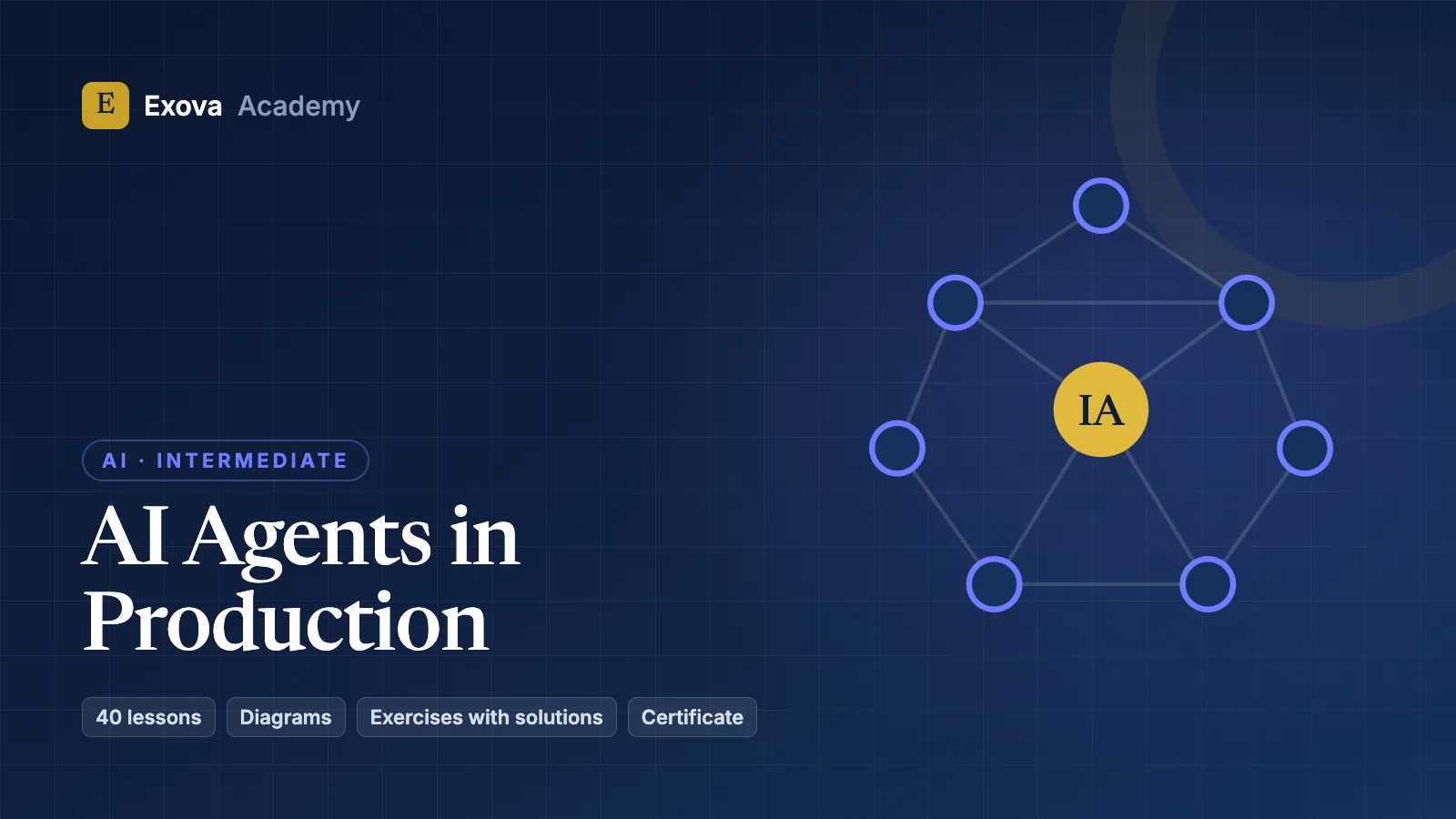
Design, build, evaluate, and deploy reliable AI agents with the Claude API, from the first call to production.
A question about this course? contact@exovatech.ltd
Yes. All the lessons, diagrams, commented code, exercises with solutions, and quizzes are free to access: you just need to create an account on the platform. Only the use of Anthropic's API in module 3 is billed by Anthropic, based on usage; the exercises use very little.
No. Modules 1 and 2 contain no code. In module 3, every line of Python is commented and the installation commands are given step by step. If you can copy, paste, and run a command in a terminal, you can follow along.
The code uses Claude Sonnet 5 (identifier "claude-sonnet-5"), a very good balance for agents. The course also explains when to prefer Claude Haiku 4.5, faster and cheaper, or Claude Opus 5.5, the most capable.
If you want to go further, the full course "AI Agents in Production" teaches you, in 40 lessons, how to build a complete support agent: advanced tools, MCP, RAG, multi-agent systems, evaluations, security, cost control, and deployment to production. There's no rush: your first agent is already a solid foundation for experimenting.
$0 · lifetime access · 14-day money-back guarantee
Buy the course